Honest feedback. In two halves.
Every rep is scored by AI, and you can check its work. We keep what you said apart from how it sounded, show you the evidence behind every number, and let you rate every part of every report.
Five for what you said. Five for how it sounded.
Thinking and delivery are separate skills, and each one can hide the other. A calm voice can make a thin idea sound substantial. A shaky one can make a sharp idea sound unsure. So they are scored apart.
Thinking
What you said, and how well it was built.
Depth of Ideas
How far past the obvious answer you get.
Thinking Lens
Whether a mental model shaped the answer.
Framework Use
Whether the answer had a shape you could follow.
Use of Examples
Concrete instances rather than general claims.
Conciseness
Said once and left alone, rather than circled.
Not about speed, and not about length.
Delivery
How it sounded, heard from the audio of a Cold Stage. Learn trains each one in Your Voice.
Conviction
Statements that land rather than lift into a question.
About landing a point, not volume. A quiet voice can have plenty of it.
Pace & Cadence
Rate and variation. A pace a listener can follow, changed on purpose.
Energy
Pitch and volume dynamics. What makes a listener lean in.
Articulation
Word endings that land and vowels that hold under pressure.
Not an accent score. An unfamiliar accent is never marked down.
Intentional Pauses
Placed silence rather than stalls.
A pause that lets a point land, not one spent searching for the next word.
Where you started. Where you are.
On day one you give a few short spoken answers. They set your baseline on all ten dimensions, and it stays put, so every change is measured against the same start.
Where you started. It never moves.
Where your recent Cold Stages put you.
Progress shows the change since you started, a trend line against your baseline, and what moved: the dimension that improved most, and the one that barely moved or slipped.
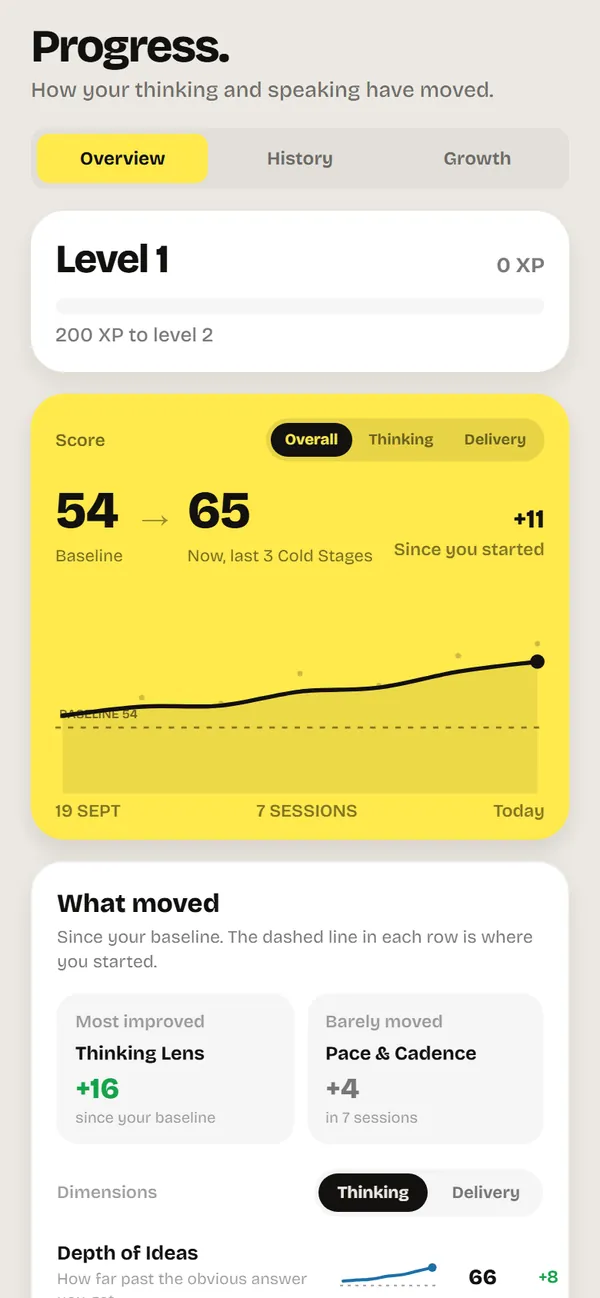
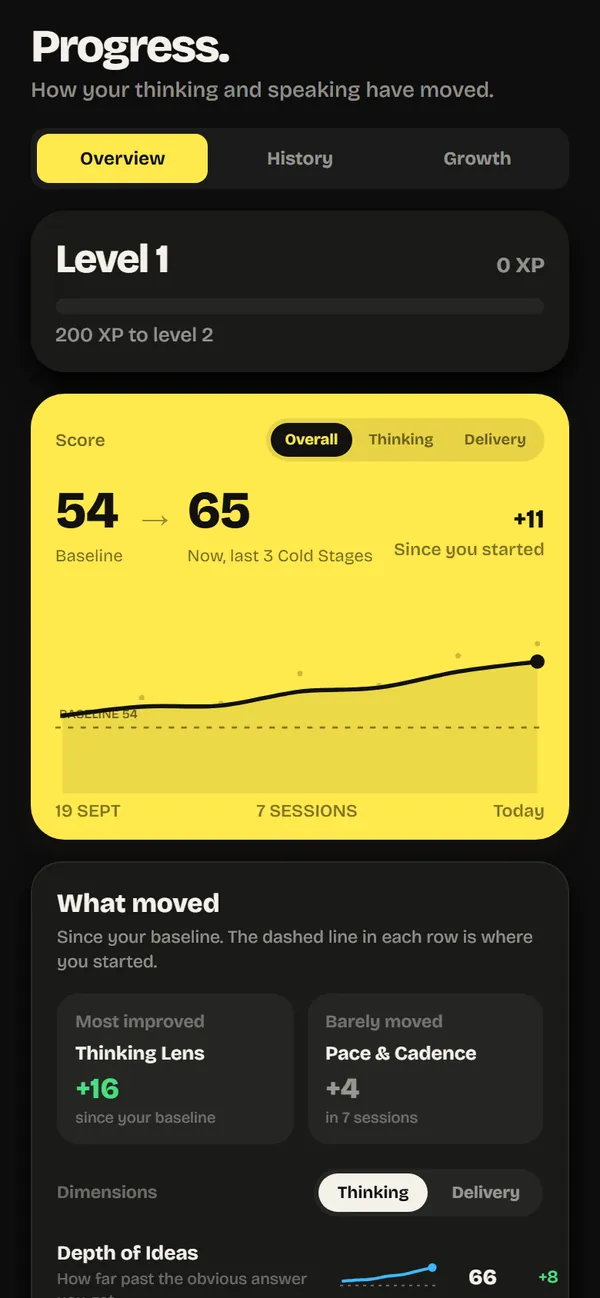
App screen with sample data.
The same shape every time. Learn it once.
Every report runs in the same order, so you always know where to look.
- The diagramYour ladder, your bridge, your reframes, or the style wheel with the style you were asked for and the one that came out.
- The summaryWhat happened in the rep, in a few lines.
- Where it can be sharperOne thing. What you said, a better version of it, and the move behind it.
- What I saw you doThe lens and shape you used, and your transcript.
- The numbersThe dimensions this rep trained, and how each has moved.
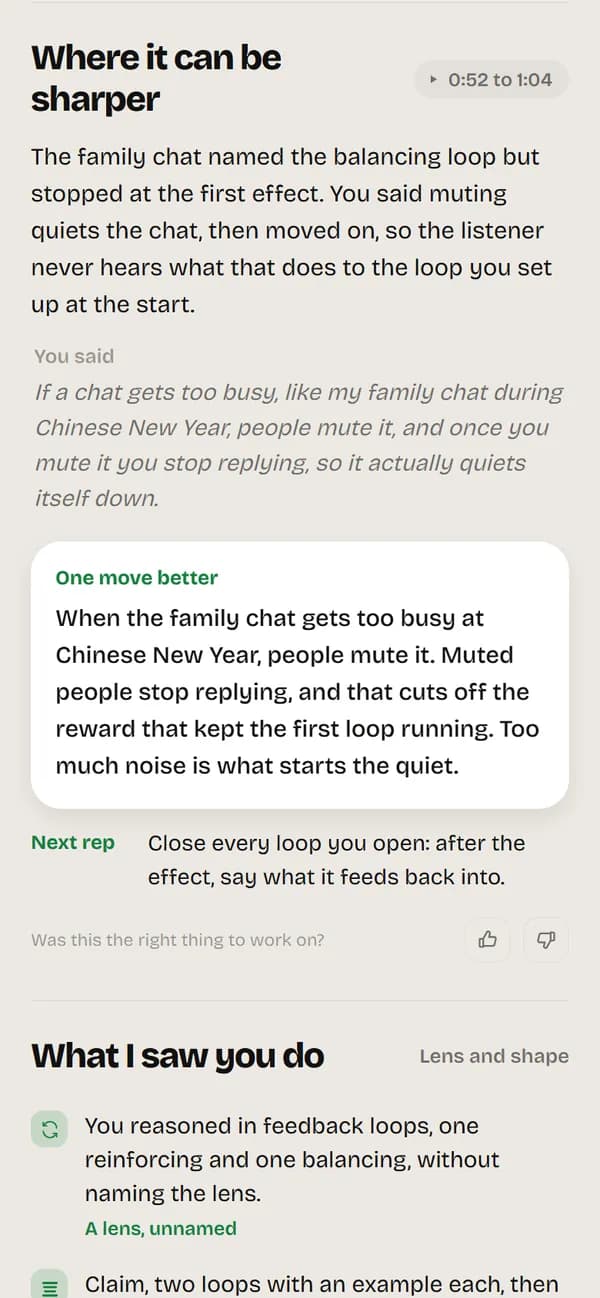
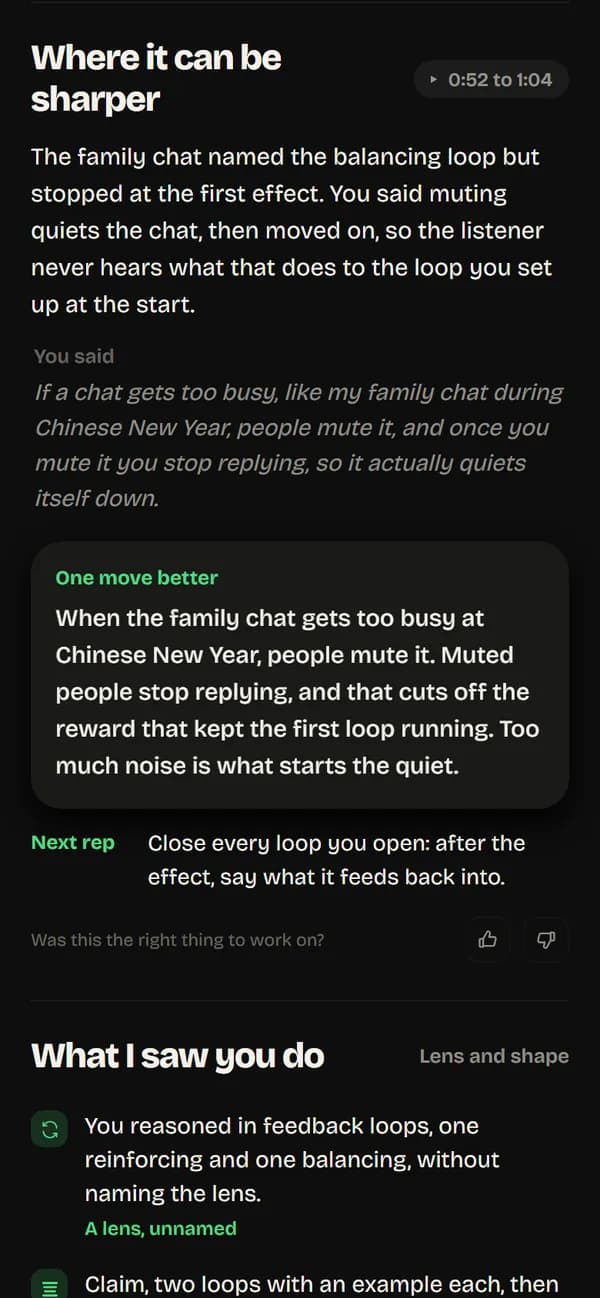
Cold Stage: two tabs
Thinking and Delivery, each with its own score. Thinking covers structure, mental model, depth, examples, conciseness and style. Delivery covers conviction, pace, energy, articulation, pauses and fillers. Each part opens to what it measures, the evidence from what you said, and one fix.
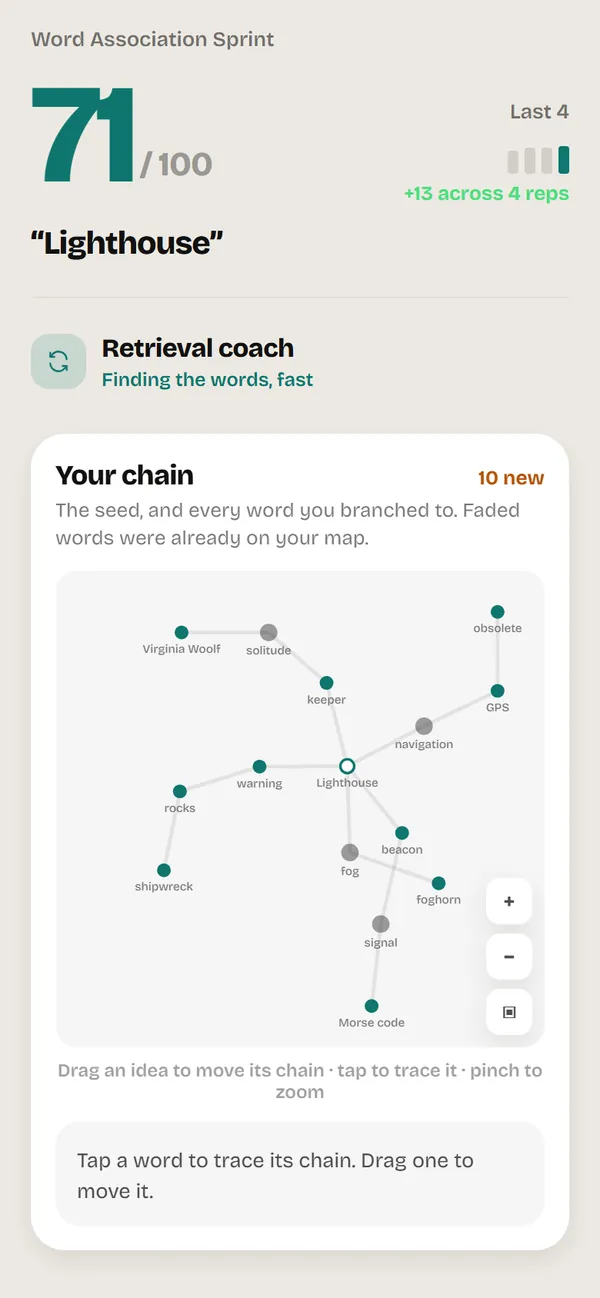
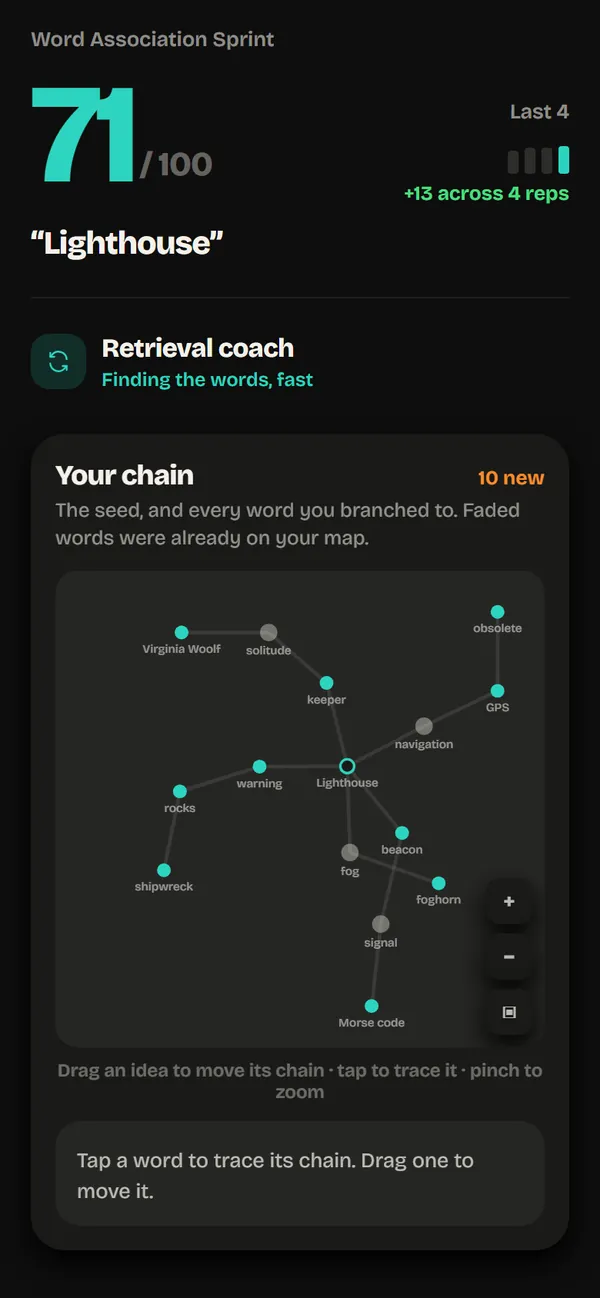
Fast word drills: no narration
Word Association and Don’t Say It do not retell what you said. They show your chain, the jumps you could have made, the word you were reaching for, and one thing to try next round.
App screens with sample data.
AI-generated, and it says so.
ThinkProv's feedback is written by AI models from Anthropic and Google. Every report ends with an AI-generated label and a plain line: it can get things wrong, rate each part.
- The summaryDid this read you right?
- Where it can be sharperWas this the right thing to work on?
- What I saw you doDid it hear this right?
- The numbersDo these scores feel fair?
- The whole reportOverall, was this report useful?
After a thumb, you can say what worked or what was off, such as too generic, made something up, too high or too low. Anything marked offensive or harmful is flagged for review.
Your voice, plainly
- Nothing is processed until you agree to it.
- Your recordings stay on your phone for as long as you choose. Apart from your baseline, which is deleted once it is scored, recordings are sent for analysis and never stored by us.
- Cold Stage video never leaves your phone.
- Google does not train its models on your audio, and Anthropic does not by default. Deepgram, which turns drill audio into text, may keep samples to improve its own speech models.
- Transcripts, scores and feedback are kept until you delete them. Privacy policy
One rep a day. Not an hour.
A short daily program that adapts to how your recent reps went.